
MAKO TOTAL KNEE • ROBOTIC ARM-ASSISTED SURGERY
Robotic Knee Replacement
Mako SmartRobotics™ helps to perform precise total knee replacement surgery with patient-specific 3D CT planning, dynamic ligament balancing during surgery, and AccuStop™ haptic technology.
To know more, to intervene in less tissue. The robotic system does not replace the surgeon; it provides the surgeon with measurement and boundary support while executing the plan.
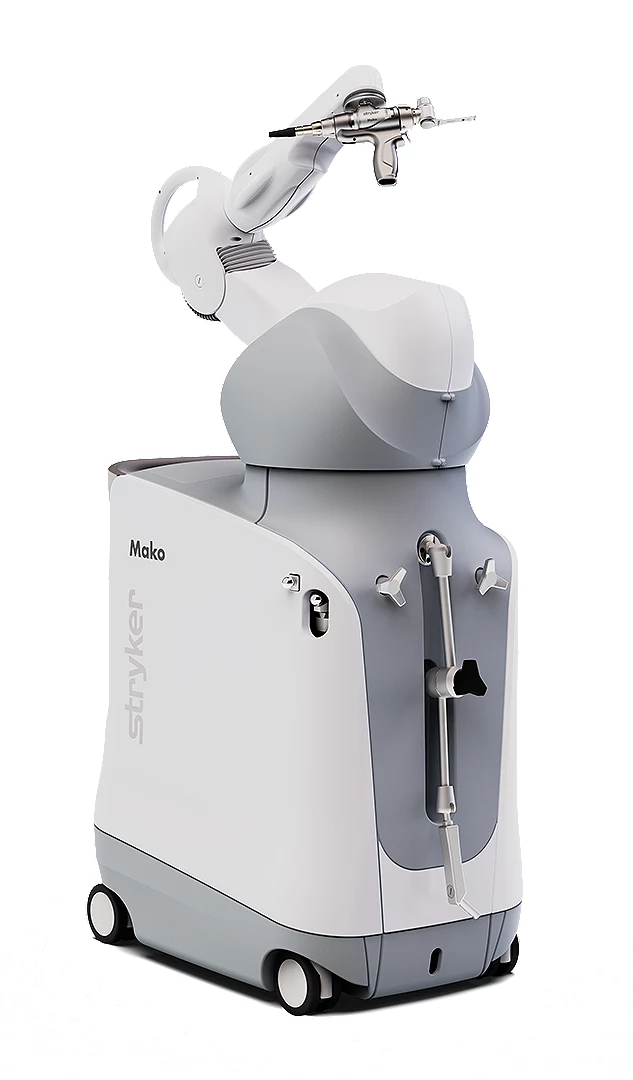
NOT ALL ROBOTIC SYSTEMS ARE THE SAME.
The Mako difference: personalized planning, dynamic balance, haptic limits.
In knee replacement surgery, the goal is not just mechanical alignment, but also the three-dimensional anatomy and soft tissue balance of the patient's knee. The Functional Knee Positioning™ approach combines these three components in a single workflow.
*Stryker 2024 internal sales data. These figures do not pertain to Turkey or a single center.
FUNCTIONAL KNEE POSITIONING™
A personalized knee plan in three stages.
3D IT-based planning
A knee model of the patient is created from CT data. Implant size and placement are planned in the sagittal, transverse, and coronal planes.
Dynamic joint balancing
Medial and lateral ligament tension is assessed. Implant placement is precisely adjusted to accommodate soft tissue balance.
AccuStop™ haptic technology
The saw is held within a patient-specific virtual boundary. The aim is to help protect surrounding soft tissues while precisely executing the plan.
VIEW THE SYSTEM IN MOTION
Transferring the plan to surgery
The video shows the Mako workflow, where the robotic arm is guided by the surgeon and bone preparation is performed within predefined virtual boundaries.
This video is a technical product demonstration of Stryker and may contain footage intended for healthcare professionals.
MAKO WORKFLOW
Planning, balancing, and haptic implementation screens.


FINDINGS REPORTED IN THE STUDIES
Expected results vary from person to person.
Accuracy according to the plan
3D CT planning and haptic margins can help ensure that prosthesis placement is more accurately implemented according to the intended plan.
Less early pain
Some studies have reported less early-stage pain and less use of analgesics compared to manual total knee replacement.
Early functional recovery
Studies have shown that some patients achieve postoperative goals sooner and are discharged earlier.
FREQUENTLY ASKED QUESTIONS
About robotic knee replacement
Is the surgery being performed by a robot?
No. The surgeon manages the entire procedure. The robotic system provides support for personalized planning and execution within virtual confines.
Is robotic knee replacement necessary for every case of knee osteoarthritis?
No. The decision regarding a prosthesis is made by evaluating the patient's symptoms, physical examination, X-ray findings, and response to non-surgical treatments.
Does robotic surgery guarantee a faster recovery?
No guarantee is given. The technology supports precise application; recovery is closely related to age, muscle strength, additional illnesses, and rehabilitation.
Selected sources
- Kayani B, et al. J Arthroplasty. 2018;33(8):2496–2501.
- Deckey DG, et al. Bone Joint J. 2021;103-B(6 Supple A):74–80.
- Therefore, B, et al. Bone Joint J. 2018;100-B(7):930–937.
- Lewis PL, et al. Australian Orthopaedic Association National Joint Replacement Registry, 2024.
This information is for informational purposes only and does not substitute for examination or personalized treatment advice. Mako, SmartRobotics, AccuStop, Triathlon, and Functional Knee Positioning are trademarks of Stryker.